
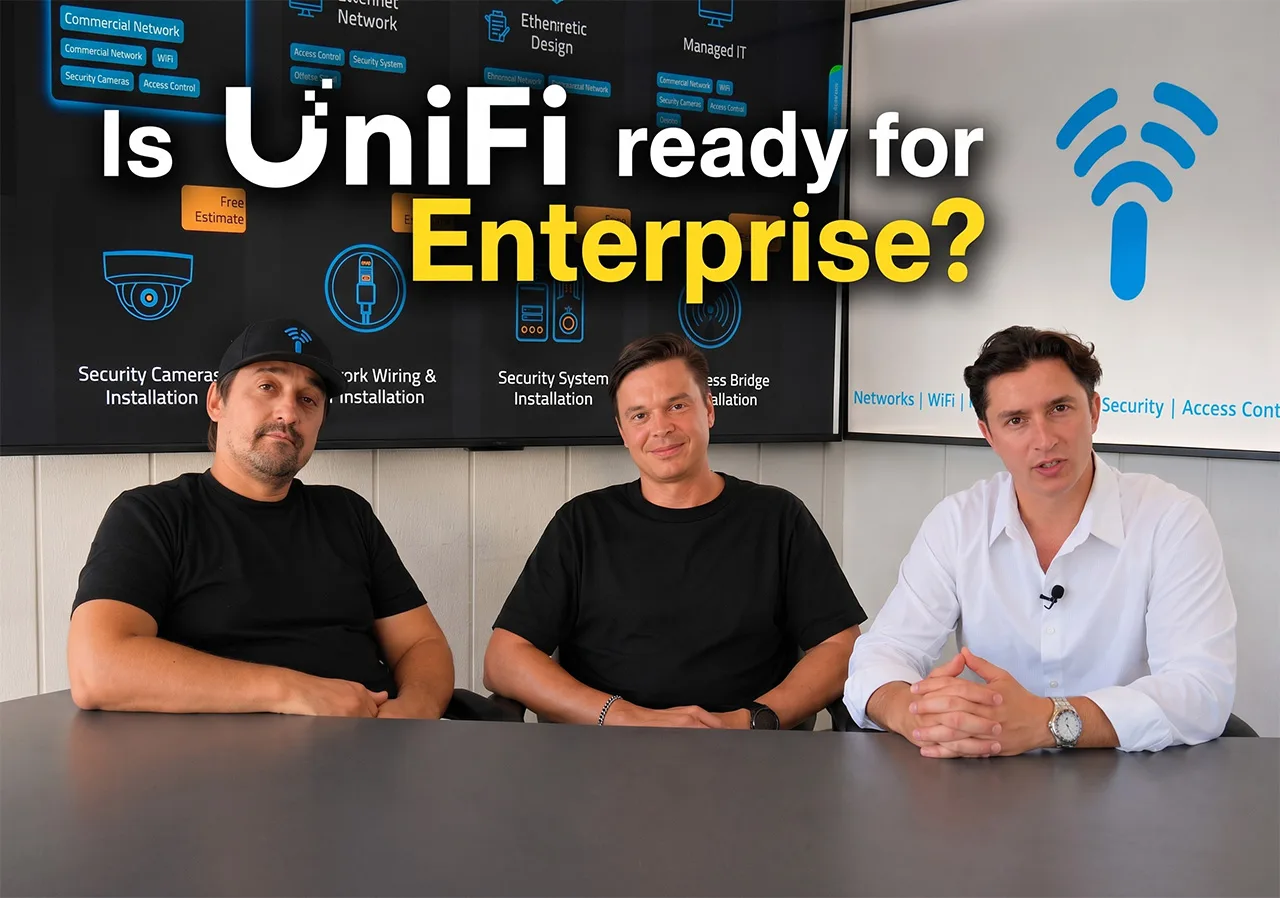
Key Takeaways: Evaluating whether a networking ecosystem is suitable for commercial use requires examining real-world deployments rather than relying on outdated online forums. Modern UniFi architecture has evolved significantly, offering scalable IT infrastructure that encompasses networking, advanced physical security, and access control within a unified platform. While the ecosystem easily handles massive 1,000,000 square foot logistics facilities, businesses must evaluate strict government compliance like CMMC before deployment.
UniFi is becoming an increasingly popular platform for commercial networking and physical security. However, the best way to understand its true technical capabilities is to see how it performs in live production environments. Recently, the Pipl Systems team visited several commercial sites in the Los Angeles area and beyond where UniFi solutions have been deployed by YesTechie. We sat down with the founders, Anton Kuznetsov and Vladimir Chasovskikh, who officially operate as certified Ubiquiti integrators, to discuss their experience designing, deploying, and supporting these systems for modern businesses. The core of our conversation addresses a major question for business owners and IT decision makers looking to upgrade their infrastructure: Is Ubiquiti ready for enterprise?
Expert Interview
Oleg Bordiian: We have spent the last few days visiting real-world commercial projects in Los Angeles, where you successfully installed UniFi networking and security systems. I want to ask a few questions about these deployments and discuss how these solutions actually work for enterprise-level companies. Five years ago, Ubiquiti products were mostly known for residential projects or small to medium-sized businesses. Do you agree with this assessment, and how do you see the evolution of the brand?
YesTechie team: We mostly agree with that historical view. However, in the last two to three years, a lot of things have changed rapidly. Ubiquiti expanded its product lines at an incredible scale. They are a fast-growing, highly innovative company that releases new products almost every month. Five years ago, their network products were decent for small and medium enterprises, but today, an entire IT infrastructure can run securely on Ubiquiti. Back then, the physical security and access control ecosystems simply did not exist. Now, they cover specific commercial needs, including an impressive security camera lineup, access control systems, and a growing range of environmental alarm sensors. It is highly convenient because businesses can manage all aspects of their IT infrastructure under a single unified platform.
O: When you talk with customers or industry colleagues who do not have your hands-on experience, what are the biggest misconceptions about the UniFi ecosystem today?
Y: There is a lot of online misconception because the company innovates so quickly. People often judge the hardware based on the product lineup from two or three years ago. Recently, they released true enterprise-grade hardware for physical security, like the new NVR Core line. They massively increased camera capacity and overall system performance, and a large portion of these major architectural updates happened just in the past six months.
O: People often debate whether Ubiquiti can handle the "enterprise" sector. What actually defines an enterprise project in your experience, and what types of businesses are you designing these networks for?
Y: "Enterprise" is a very broad term. We actually avoid defining it rigidly because business requirements vary wildly. If you are securing a hospital or an airport, you have strict legal compliance, heavy regulations, and highly critical daily operations. But let us look at a recent practical example. We designed a system for a massive warehouse facility spanning around 1,000,000 square feet. That deployment includes 60 to 80 Wi-Fi access points, hundreds of surveillance cameras, and comprehensive door access control. Is that considered enterprise? When we speak with clients, we focus strictly on understanding their operational needs. In 95% of business cases, the UniFi ecosystem is a perfect fit.
O: Since you mentioned 95%, what about the remaining 5%? In what specific situations does Ubiquiti fall short, or where is it not the best choice?
Y: The main limitation right now involves the government sector and strict compliance standards. If a project requires CMMC compliance or active FIPS certification, we have to be careful. We know that some of the newer enterprise access points have the required FIPS chips physically built in, but they are not fully activated yet, according to the engineering team. We have some customers who implemented specific network workarounds to keep their Ubiquiti access points and still comply with CMMC, but it can be tricky. If a government defense contractor chooses a different networking brand to guarantee strict out-of-the-box compliance, that is completely reasonable.
Another segment where it does not fit is businesses that have absolutely no compliance standards and simply want the absolute cheapest equipment possible. Those buyers usually go with low-tier, generic brands. But for private commercial businesses investing their own capital into a reliable, user-friendly IT infrastructure, Ubiquiti remains a highly competitive choice.
O: Beyond compliance, do you feel Ubiquiti technically has everything required for a massive commercial network deployment? Is Ubiquiti ready for enterprise hardware demands?
Y: In terms of raw features and hardware performance, it is absolutely ready for any challenge. For example, we had a client with multiple sites across the US who was hesitant to migrate their network because SD-WAN functionality was critical for their daily operations. They were heavily relying on traditional enterprise brands. Recently, Ubiquiti released their new Enterprise Firewall Core and introduced robust SD-WAN capabilities. This new hardware is an absolute beast that solves complex multi-site networking problems effortlessly.
O: Many people see the brand and think the setup is incredibly simple. If the equipment is so user-friendly, what is the actual role of a certified UniFi integrator in these commercial projects?
Y: It is very simple for a basic residential setup, but building a commercial IT infrastructure requires deep strategic planning. Our role as an integrator is to deeply understand the exact business processes and design the system according to those specific operational needs. The software management interface is exceptionally easy to use, which is great for the end user, but physically building that infrastructure and selecting the correct hardware requires professional expertise. For instance, choosing the exact type of surveillance camera or configuring identity providers for an access control system can be highly complex. Ubiquiti provides excellent resources like the UniFi Design Center and capacity calculators, prioritizing the end-user experience, but businesses still require a licensed company to properly run the wiring, configure the core network, and build the physical infrastructure.
O: When you take over projects from other installers, what are the most common deployment mistakes you see, especially regarding equipment procurement and supply chain management?
Y: We frequently see outdated equipment that was sourced through third-party sellers or auction sites. Ubiquiti acts as a direct procurement platform where businesses can apply for tax exemptions and order hardware directly. In contrast, supply chain shortages and out-of-stock items can be tricky for large corporate deployments; an experienced integrator knows how to navigate this. For the 1,000,000 square foot warehouse project, we only had one month to complete two major production plant deployments located in Los Angeles and Indiana. We successfully sourced all the necessary physical security and networking equipment exactly on time. Another frequent mistake we see is inexperienced installers choosing older wireless access points when newer, significantly better-performing hardware is already available on the market.
O: What about physical security integration? Are there specific challenges you notice when standard IT installers try to deploy commercial access control systems?
Y: Yes, door hardware is a massive challenge in this industry. We spent a lot of time figuring out the exact mechanics of electrified doors and identifying the correct types of commercial locks. Often, a customer requests access control, but the physical door is not electrified yet, meaning you must engineer a complete solution so it functions correctly. Many standard network installers simply skip this part because they are not comfortable handling the mechanical door hardware or understanding local building compliance. We realized the vital need to provide a complete solution from scratch. Whether it is an empty new warehouse or a complex office retrofit, we physically electrify the locks, run all the required low-voltage wiring, and ensure the door access seamlessly connects to the wider enterprise network.
O: Let us talk about the economic shifts in the industry. There is a lot of discussion about recurring software costs, and Ubiquiti is heavily disrupting how businesses budget their IT infrastructure. How do you see the market shifting regarding licensing fees?
Y: It is becoming a clear choice for modern businesses. When a platform offers high-performing, commercial hardware with zero licensing fees, it completely changes the calculation for management teams and property owners who are spending their own capital. Traditional enterprise platforms require continuous, costly recurring subscriptions just to keep the hardware running. By removing those mandatory licensing fees, the choice becomes highly attractive for corporate environments. Furthermore, the technological innovation matches this cost advantage; they are introducing advanced management features like object-oriented networking, creating entirely new ways to manage data distribution without complex legacy setups.
O: This zero-license model seems to heavily change how physical security and IT networks interact. How do you see those two sectors coming together?
Y: Physical security is no longer an isolated trade; it is a core component of the corporate IT network infrastructure. If a business already deploys a UniFi network, they have effectively completed 50% of their physical security installation. Layering surveillance cameras and access control readers directly on top of an established network architecture is incredibly efficient. Every part of the facility infrastructure communicates natively within a single, unified interface. For internal IT teams and the integrators supporting them, managing alarms, network data, and door access from a centralized dashboard streamlines daily operations significantly.
O: This direct-to-consumer hardware model and the lack of licensing fees must be causing massive ripples for Managed Service Providers (MSPs). How is this disrupting the classic corporate service model?
Y: It is forcing a major reinvention of the traditional MSP business model. Historically, the industry relied on a gatekeeper structure; end users could not even purchase the hardware directly and had to go through a middleman who collected ongoing software maintenance and licensing fees. Ubiquiti acts as a true disruptor by removing those intermediate costs and allowing businesses to buy their gear directly. This shifts the role of the provider away from a service re-seller and squarely toward a specialized system integrator. Companies must now provide actual engineering value, specialized hardware configuration, and infrastructure layout rather than simply managing subscription licenses.
O: Because of this disruptive model, you often see a stark division online. There is an army of highly dedicated fans, but also highly vocal opponents who prefer traditional legacy brands. How do you address the online toxicity and debate surrounding the brand?
Y: The division is completely normal in a competitive free market. Many legacy professionals spent decades mastering highly complex command-line configurations for brands like Cisco. When a new platform introduces an interface that simplifies those complex setups, it can be perceived as a direct threat to that established technical expertise. Some of the online criticism stems from simple resistance to learning a new system. At the same time, some technical critiques are valid, but the engineering team actively fixes software bugs and patches performance issues rapidly based on installer feedback. Ultimately, the strongest proof of whether the hardware is ready for the commercial sector does not come from online forums, but from successful deployments and the real-world feedback of the business owners operating these systems every day.
To hear the full context of this technical discussion, including direct insights on UniFi enterprise capabilities, compliance limits, and shifts in the MSP market, watch the complete expert interview below:
FAQ Section
Is Ubiquiti suitable for large-scale enterprise environments?
Yes. Modern UniFi architecture successfully supports massive commercial footprints, including logistics hubs up to 1,000,000 square feet. With hardware like the Enterprise Firewall Core and high-capacity local NVR arrays, the ecosystem handles heavy data loads, extensive access point grids, and large camera counts smoothly.
What are the primary limitations of deploying UniFi in the corporate sector?
The primary limitations involve government-regulated environments requiring out-of-the-box CMMC or active FIPS compliance. While newer enterprise-grade hardware features integrated FIPS chipsets, full activation is still pending, making alternative legacy brands more practical for specialized defense contracts.
How does a zero licensing fee model benefit commercial operations?
A zero-license infrastructure eliminates ongoing software subscription costs, allowing businesses to retain full data ownership and lower their long-term operational expenditures. Capital can be spent entirely on physical hardware upgrades and expert installation rather than recurring software maintenance fees.
Can standard network installers handle commercial access control deployments?
Commercial access control requires specific low-voltage licensing and deep knowledge of mechanical door hardware. Standard IT technicians frequently struggle with electrifying physical doors or meeting local building and fire safety codes, which is why utilizing a certified integration specialist is essential.
What is the difference between an installer and a security integrator?
An installer focuses entirely on mounting devices on a wall based on a standard parts list. A certified security integrator analyzes specific business operations, coordinates networking infrastructure with physical security hardware, and designs a cohesive system engineered to scale alongside long-term corporate growth.